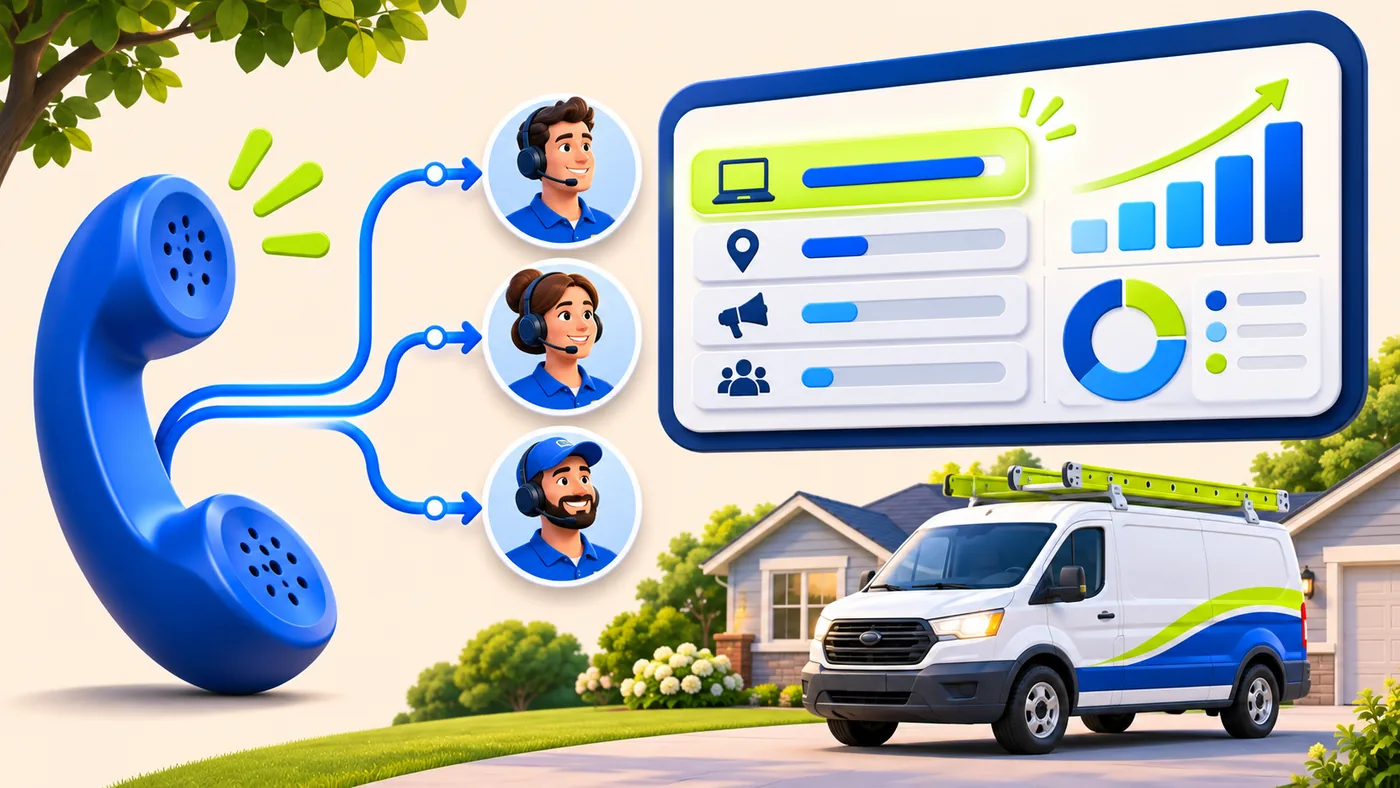
Call tracking is a way to find out which ad, web page, or listing made someone pick up the phone and call your business. Each marketing source gets its own phone number, every number forwards to your real line, and the software logs which number rang. At carrier level a local number costs $1.15 a month (Twilio's US voice pricing, checked November 9, 2026), so the numbers themselves are rarely the expensive part.
Placement is the hard part. Put a tracking number in the wrong spot and your business ends up with two competing phone numbers across Google and the directories. Below: how call tracking numbers work, what dynamic number insertion does on your website, what a call tracking report shows, and the setup choices that decide whether the data can be trusted.
What call tracking actually measures
Phone call tracking answers one question for every inbound call: where did this caller come from? A web form carries that answer with it, through the page URL and your analytics. A phone call doesn't. When a customer reads your number off a website and dials it from a cell phone, the link between the visit and the call disappears unless the number itself carries the source.
Inbound call tracking puts the source into the number. If the number on your truck wrap differs from the one in your Google Business Profile, and both differ from the one on your website, a call to any of them tells you which one did its job.
This kind of call-tracking is a marketing tool. It is different from call monitoring in a contact center, which grades how reps handle calls, and it has nothing to do with apps that track a phone's location. The software sees what your own phone system sees on any incoming call (caller ID, time, duration) plus the marketing data tied to the number the person dialed.
What is a call tracking number?
A call tracking number is a real, dialable phone number that forwards to your existing business line and records data about each call on the way through. The caller hears a normal ring. Your staff answer the same phones they always do.
You keep your main number. It stays in your directory listings, in your website code, and on your Google profile as an additional number (more on that below). Tracking numbers sit in front of it.
Most businesses pick from two kinds of call tracking phone numbers:
- Local numbers with your area code, which look like a neighborhood business and suit most local companies.
- Toll-free numbers (800, 888 and so on), a better fit for brands that sell nationally.
Twilio lists a local number at $1.15 per month and a toll-free number at $2.15, with inbound calls at $0.0085 per minute for local and $0.0220 for toll-free (Twilio). Those are base number-rental and inbound-usage rates. Forwarding to another phone number can also incur an outbound call charge, and taxes, recording and other features may cost extra. Call tracking platforms such as CallRail, CallTrackingMetrics and Invoca bundle numbers, minutes, software and reports into a monthly plan, so their prices sit well above these figures. Choosing between tools is a separate question from understanding how they work.
How does call tracking work, step by step?
Call tracking works in five steps, from the moment a customer sees your number to the moment the call shows up in a report:
- You assign a tracking number to a source: your Google Business Profile, a postcard, a radio spot, or your website.
- A customer dials that number.
- The call tracking platform logs the number dialed, the caller ID and the time, then forwards the call to your business line.
- Your team answers as usual. If recording is on, the platform records the call and may transcribe it.
- The call lands in your dashboard tagged with its source and duration, and with the outcome someone marks: booked job, quote, wrong number, spam.
Step 5 is where the value is. A call without an outcome tag is only a count.
Offline sources each get one fixed number. A website needs more than that, because one site gets visitors from a dozen sources at the same time.
Static numbers vs dynamic number insertion
Static (source-level) call tracking gives each campaign one number that never changes. It is the only option for places where you can't run code: billboards, flyers, vehicle wraps, print ads, radio, your Google Business Profile. A static number tells you the channel. It can't tell you which keyword or which page.
Dynamic number insertion call tracking (DNI) handles the website. You add a JavaScript snippet from your call tracking provider to every page. When someone lands on the site, the script checks how they arrived (organic search, a paid ad, a Facebook post, an email) and swaps the phone number on the page for one tied to that source or to that specific visitor.
Dynamic call tracking comes in two levels:
- Source-level DNI shows one number per traffic source. Everyone from organic search sees number A and everyone from paid search sees number B. Few numbers, channel-level data.
- Visitor-level (session-level) DNI gives each visitor a number of their own from a pool for as long as they browse. If that visitor calls, the platform knows the whole visit. CallRail's visitor tracking documentation lists what it attaches to the call: source, paid keyword, landing page, full page-view history, referring domain, UTM parameters, device type, caller ID and city.
When the visitor leaves, the number goes back into the pool for the next person.
How many numbers a visitor pool needs
You need about one number for every visitor who is on your site at the same moment. CallRail's sizing rule is to take your busiest hour of traffic from Google Analytics, divide it by four, and never go below four numbers per pool (CallRail, how to calculate the size of your website pool).
Here is what that looks like for two hypothetical sites:
| Peak visitors in one hour | Pool size (peak / 4, minimum 4) | Carrier cost of the numbers at $1.15 each |
|---|---|---|
| 12 | 4 (minimum applies) | $4.60 per month |
| 40 | 10 | $11.50 per month |
| 100 | 25 | $28.75 per month |
The cost column uses Twilio's carrier rate and leaves out minutes and software fees, so treat it as the floor. Seasonal businesses should size the pool from their peak season, which CallRail's guide also suggests. A pool that is too small forces visitors to share numbers, and the platform can no longer tell whose visit produced the call.
Where each call tracking number should go
Most setup mistakes happen here, and vendor guides spend the least time on it. Your main number is part of your NAP (name, address, phone), and Google and directory sites compare it across the web. A tracking number that leaks into the wrong place gives your business a second, competing phone number.
| Where the number appears | Which number to use | Why |
|---|---|---|
| Visible phone number on your website | DNI tracking number, swapped by the script | Shows the source for each visitor |
| Phone number in the page's own text and HTML | Your main number | CallRail notes that the main number stays in the HTML, where search engines can index it (CallRail) |
| Google Business Profile, primary phone | A static tracking number used only for the profile | Separates profile calls from website calls |
| Google Business Profile, additional phone | Your main number | Keeps the profile tied to the number in your other listings |
| Yelp, BBB, Yellow Pages and other directories | Your main number | Keeps NAP consistent |
| Print, vehicle wraps, radio, direct mail | One static number per campaign | No code runs there |
Google lets a Business Profile carry a primary number plus up to two more (Google Business Profile Help). The tracking-number-as-primary setup comes from CallRail's Google Business Profile guide. Google confirms the number limit, while CallRail recommends keeping your main line as an additional number. After making the change, check the number customers actually see in Search and Maps.
In our local SEO audits we compare a business's citations against a fixed list of directories (Yelp, BBB, Yellow Pages, MapQuest, social profiles and niche sites) and check the phone number on every listing. A tracking number someone pasted into a directory years ago counts as a mismatch in that check, and it keeps ringing through to you, so nobody notices.
A related problem we find on small-business sites: the address and phone number appear only after JavaScript runs. DNI is JavaScript too. So keep your main number in the plain text of the page and let the script swap only the copy visitors see. When we work on a client's Google Business Profile, we also add UTM parameters to the profile's website link, so visits from the profile don't get lumped in with organic search in reports.
What call tracking reporting shows
Call tracking reporting turns phone calls into numbers you can set next to your marketing spend. A typical dashboard shows:
- calls by source and campaign, split into first-time and repeat callers
- answered and missed calls, by hour and day
- duration, caller ID and city
- landing page and keyword for website calls (CallRail's documentation notes that keywords come through only for paid search traffic, not organic)
- recordings and transcripts, if you turn them on
- outcome tags such as booked, quote sent, existing customer, spam
The outcome tag is the column to build decisions on. Cost per call can point you to the wrong channel. Look at this hypothetical comparison of two channels with the same budget:
| Channel A | Channel B | |
|---|---|---|
| Monthly spend | $1,500 | $1,500 |
| Calls | 60 | 30 |
| Booked jobs | 9 | 15 |
| Cost per call | $25.00 | $50.00 |
| Cost per booked job | $166.67 | $100.00 |
Judged by calls, Channel A looks twice as efficient. Judged by booked jobs, Channel B costs $66.67 less per customer. You only see the second view if someone tags outcomes, either by hand after each call or through the AI call scoring that some platforms sell.
Missed-call data is the other report worth reading every week. Say 1 in 5 calls between 5 and 7 p.m. goes unanswered: that is a staffing problem, and no ad budget will fix it. For businesses that run several channels, our lead tracking service puts calls and form fills into one report, so phone leads stop living in a separate spreadsheet.
Call tracking tells you which number rang. How much credit an earlier ad or email deserves for that call is a separate attribution question, and the call data is only one input to it.
Why use call tracking, and when it adds little
Call tracking is worth paying for when the phone is how customers buy from you and you spend money on more than one channel. If you run Google Ads, a Business Profile, some SEO and a direct-mail drop at the same time, call tracking is the only way to compare them on phone leads. Without it, your only data is whatever callers remember when someone asks "how did you hear about us?"
It adds little in two cases:
- Almost all your business comes from one channel with one number. You already know where calls come from.
- You won't tag outcomes. Then you are paying for a call counter.
There are also limits on accuracy. A customer who saves your number from a past visit and calls months later gets credited to the source behind that saved number. Someone who sees your van, searches your name and calls from your Google profile counts as a profile call, not a van call. And DNI depends on JavaScript running in the visitor's browser, so a visitor whose browser blocks the script sees your main number and their call shows up without a source.
Service call tracking is a natural fit for plumbers, HVAC companies and electricians, where most jobs start with a phone call. If you run Google Ads for a home service business, call data is what tells you which campaigns bring jobs and which bring price shoppers. Automotive call tracking usually splits dealership sales, service and parts lines onto separate numbers so each department sees its own sources. Healthcare call tracking works the same way mechanically, with extra privacy rules covered next.
Call recording consent and HIPAA call tracking
Federal law generally permits recording with one party’s prior consent, subject to exceptions including recordings made for a criminal or tortious purpose, under 18 U.S.C. 2511(2)(d). Some states go further. California Penal Code 632 requires the consent of all parties to record a confidential communication, with a fine of up to $2,500 per violation for a first offense and potentially higher penalties for prior convictions. Callers can dial in from different states, and a generic recorded announcement does not automatically satisfy every applicable consent rule. Before enabling recording, have a lawyer review the states involved, the notice and consent process, and what happens when a caller declines.
Healthcare adds HIPAA. The HHS Office for Civil Rights guidance on online tracking technologies says a tracking vendor that handles protected health information (PHI) on behalf of a regulated entity may be a business associate and requires a business associate agreement (BAA) when that relationship applies. The disclosure must also be permitted under HIPAA; a BAA by itself does not authorize every use of PHI. A cookie banner or privacy policy does not replace a required BAA or HIPAA authorization. In June 2024 a federal court vacated the guidance to the extent that it treated the combination of an IP address and a visit to certain public, unauthenticated health pages as automatically triggering HIPAA obligations. This does not exempt all tracking on public pages; actual PHI disclosures still require review.
For HIPAA call tracking, ask any vendor two questions before you sign: will you sign a BAA, and does that BAA cover call recordings, transcripts and the website script? Visitor-level DNI on appointment pages and recorded patient calls are where protected health information shows up.
Questions people ask about call tracking
Does call tracking hurt local SEO?
It can if tracking numbers end up in your directory listings or replace the main number in your page's HTML. Keep your main number in citations and in the page text, use DNI to swap only the visible number, and put your main line in your Google Business Profile as an additional number.
Do I have to change my business phone number?
No. Tracking numbers forward to the number you already have. Customers who have your main number saved keep calling it, and it keeps working. Those calls just don't carry a marketing source.
Can a business see my location when I call a tracking number?
Not in the sense of GPS. A call tracking platform records what any phone system sees, such as caller ID and the city tied to it, plus details of your website visit if you called a number shown to you there. It doesn't track where your phone is.
How many call tracking phone numbers do I need?
One static number per offline campaign or listing you want to compare, plus a website pool. CallRail's rule for the pool is your busiest hour of visitors divided by four, with a minimum of four numbers.
Is call tracking HIPAA compliant?
Call tracking can be set up to meet HIPAA requirements, but compliance depends on the vendor and the setup. Under HHS guidance, determine whether the vendor is acting as your business associate, put a BAA in place when required, and confirm that the planned disclosures are permitted. Review recordings, transcripts and the website script as part of that assessment.
Before you buy call tracking: a short checklist
Most setup problems trace back to decisions made in the first hour. Settle these before you pick a tool:
- List the sources you actually want to compare. Each one needs its own number.
- Decide where you need static numbers and whether your website needs source-level or visitor-level DNI.
- Size the website pool from your peak hour of traffic, divided by four.
- Plan your Google Business Profile setup and leave your main number in every directory.
- Keep the main number in your page text and HTML.
- Enable recording only after reviewing the applicable consent requirements. If PHI is involved, review permitted disclosures and obtain a BAA when the vendor acts as your business associate.
- Agree on three or four outcome tags and who applies them.
- Call every tracking number yourself once it is live and confirm it rings through and shows up in the report.
If you want help setting this up, Next Wave Group handles call and form tracking as part of our lead tracking service. We start with your goals, service area and existing lead flow, then agree on the work that fits your business. Tell us which channels you are paying for now and we will reply the same business day.
Put the next step into action.
Tell us about your business, service area and goals.
Get More LeadsExplore lead tracking services