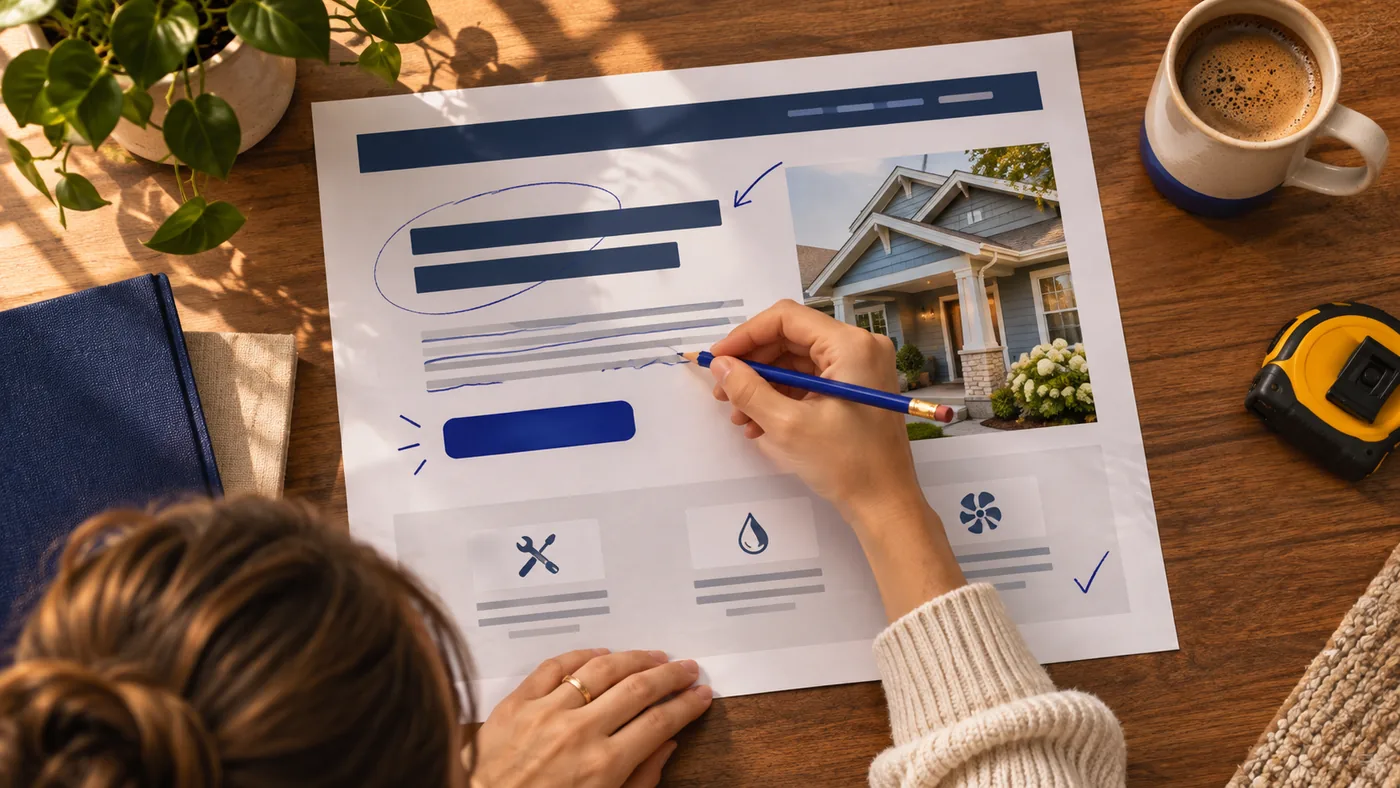
CRO content is the copy on a page written to get one kind of visitor to take one action: call, book, request a quote or buy. It is measured by conversion rate. In Unbounce's 2024 data on more than 41,000 landing pages and 57 million conversions, pages written at a 5th to 7th grade reading level converted at 11.1%, more than double the 5.3% of pages written at a professional level (Unbounce Conversion Benchmark Report).
That gap comes from words. You can close part of it this week with nothing but a text editor.
This guide covers the writing side of conversion rate optimization for small and local businesses: what the first screen should say, how to order a page, which proof people believe, how to answer objections before the phone rings, how to word a button, and how to tell whether new copy did anything. Speed, layout and form fields belong to landing page optimization, and the full testing workflow belongs to the CRO process. Here they get a sentence each.
What CRO content has to do on a page
CRO content answers the questions a visitor has right before deciding, in the order they come up. For a local business those questions are predictable. Do you do this exact job? Do you work where I am? Can I trust you? What happens when I call, and what will it cost?
Many small business pages answer other questions. They open with "Family owned since 1998," list every service in one paragraph and leave the phone number for the footer. The owner wrote about what they are proud of. The visitor wanted to know whether someone can come today.
Before writing a word, finish this sentence: "This page is for [one person] who wants to [one action]." "A homeowner in Katy with no hot water who calls now" gives you a page. "Anyone who might need plumbing" gives you a brochure.
Start from what the visitor already read
The first screen should continue a conversation the visitor started somewhere else. Few people arrive cold: they clicked an ad, a Google Business Profile, a map pin or a review, and each of those set an expectation. The headline either confirms it or sends them back.
Reviews send a lot of people to websites. In BrightLocal's Local Consumer Review Survey 2026, 54% of consumers said they visit a business's website after reading positive reviews, up from 32% when BrightLocal last asked in 2019 (BrightLocal, Local Consumer Review Survey 2026). Those visitors already lean your way. The page only has to keep them.
For paid traffic Google states the rule outright. Its help page on landing pages tells advertisers to pick a page that closely matches the ad and keywords, to show the offer from the ad and to "mirror the call-to-action in your ad text" (Google Ads Help, Optimize your ads and landing pages). Landing page experience is also one of the three parts of Quality Score, defined as how relevant and useful the page is to people who click the ad (Google Ads Help, About Quality Score). If you run Google Ads for a local business, the ad and the page copy should be written together.
| Where the visitor came from | What they already believe | What the first screen should say |
|---|---|---|
| Search ad for "emergency AC repair" | You fix AC today | The same service and urgency, the offer from the ad, the phone number |
| "Website" link on your Google Business Profile | You are local and have the rating they just saw | The area you serve, your rating and review count, the main service |
| A review that names a specific job | Someone like them got that job done well | That job by name, with a similar result or photo |
| Facebook or Instagram ad | They were not searching; the ad made the case | The ad's promise in the headline and a low-commitment next step |
| Organic search for a cost or how-to question | They are still researching | The answer first, then the reason to contact you |
The second row is easy to get wrong. A profile click lands on a generic homepage, and the visitor has to find the service and the city again. Matching the page to your Google Business Profile categories and services fixes that with copy alone.
Write the value proposition before the headline
A value proposition is one or two sentences that say what you do, for whom or where, and why someone should choose you over the next tab. The headline comes out of it. Writing headlines first usually produces slogans.
A simple formula for local businesses:
[Specific service] for [specific customer or area] + [a difference that is true and checkable]
| Generic copy | CRO content version (use only if true for you) |
|---|---|
| Quality plumbing services you can trust | Same-day water heater replacement in north Houston, with the price confirmed in writing before work starts |
| Your smile is our priority | Family dentist in Spring with Saturday appointments and online booking |
| Experienced legal representation | Uncontested divorce in Harris County, with a flat fee quoted on the first call |
| Professional pet grooming | Grooming for anxious dogs: one dog in the salon at a time, no cages |
The difference has to be real. When we plan a page for a client, we read the top five competing pages of the same type and look for one thing the business has that none of the five shows: a warranty term, weekend hours, a license others lack, photos of real local jobs. That item goes on the first screen. If nothing turns up, better copy will not fix it, because the offer itself needs work.
Order the page by the doubts people raise
Structure CRO content in the order doubts appear, so each section answers the next question before the visitor asks it. People do not read the whole page. Jakob Nielsen's analysis of browsing data found that users read about 20% of the words on an average web page (Nielsen Norman Group, How Little Do Users Read?). The data is old (collected in 2005, published in 2008), so treat the exact figure loosely. The writing rule holds either way: every heading has to make a full point on its own.
A working order for a service page:
- Headline: the service and the area, in the words customers use.
- A subheadline with your main difference and the next step (call, book or quote).
- Proof near the top, such as your rating with review count or one review about this exact service.
- What the service includes, and what it does not.
- What happens after someone calls: the steps, the timing, who shows up.
- Price: a range, a starting price, or how the quote works and when the customer will know the number.
- Answers to objections, often as a short FAQ.
- The call to action again, worded the same as the first time.
Items 5 and 6 are cheap to write and remove the biggest unknowns. A visitor who knows what the first call sounds like and roughly what the job costs has fewer reasons to keep shopping.
Proof that a skeptical visitor believes
Specific proof works better than general proof. "5-star service!" proves nothing. A real review saying the tankless heater was fixed the same afternoon and the bill matched the quote answers two objections in one line.
BrightLocal's 2026 survey shows what people check:
- 74% of consumers only care about reviews from the last three months.
- 47% won't use a business with fewer than 20 reviews, and only 9% would use one with five or fewer.
- The top trust factor (56%) is a review backed up by other reviews with similar sentiment.
- 31% will only use a business rated 4.5 stars or higher, up from 17% a year earlier.
For copy, that means showing the review count and recency next to the stars, rotating in recent reviews, and picking reviews that mention the job the page is about. A plumbing page that quotes a review about a kitchen remodel wastes the spot.
| Proof type | Where it fits | How to write it |
|---|---|---|
| Rating and review count | Every page, near the top | Put the number of reviews next to the stars and link to the source |
| Review about a specific job | Service pages | Match the service; use the first name and town only with permission |
| Before and after photos | Remodeling, cleaning, landscaping, auto detailing | Caption what was done and where |
| Licenses, insurance, certifications | Trades, healthcare, legal | Give the license number so it can be checked |
| Results with numbers | B2B services, agencies | Only real numbers, with the time period |
Keep all of it real. The FTC's rule on consumer reviews and testimonials, announced on August 14, 2024, bans fake reviews and testimonials (including AI-generated ones attributed to people who don't exist), reviews bought on the condition that they are positive, and insider reviews without a clear disclosure. It lets the FTC seek civil penalties against knowing violators (FTC press release). A placeholder testimonial "until we get real ones" falls under it.
Answer objections in the copy, before the sales call
Every question a prospect has to call about is a chance for them to call someone else. The best source for objections is your own data: the questions your front desk answers every day, call recordings, and complaints in competitors' reviews. Write the answers into the page where the doubt shows up.
| Objection | Copy that answers it | Where it goes |
|---|---|---|
| "The final bill will be higher than the quote" | How the price is set and when it is confirmed in writing | Next to the CTA and in the price section |
| "Will they show up on time?" | The arrival window and how you notify the customer | "What happens next" |
| "Is this company legit?" | License number, years under the same name, a street address in the text | Proof section and footer |
| "I'm not sure I need this service" | Signs that point to the problem, and who doesn't need it | Middle of the page |
| "Calling means a hard sell" | What the first call covers and how long it takes | Under the button |
| "They probably don't come out this far" | Service area cities listed by name | First screen and a service area section |
Say the uncomfortable parts plainly. "Diagnostic visit: $89, credited toward the repair if you go ahead" turns a hidden fee into a reason to call. The numbers here are an example; use your own.
CTA copy: say what happens after the click
CTA copy converts when it names the action and what the visitor gets. "Submit" names neither. The button, the line under it and the phone number together make the CTA.
| Weak | Stronger | Why |
|---|---|---|
| Submit | Get my quote by text | Says what arrives and how |
| Contact us | Book a free estimate for this week | Names the offer and the timing |
| Learn more | See drain cleaning prices | Promises a specific answer |
| Sign up | Save my spot for Saturday | Uses the visitor's own goal |
Under the button, add one line of microcopy about what happens next: "We reply the same business day" or "A technician calls you back within 15 minutes," but only if your team actually does it. A promise the front desk can't keep converts once and then shows up in a review.
Keep one primary action per page and word it the same way in the header, mid-page and at the end. A secondary action is fine for visitors who are not ready, such as a price guide.
One technical detail belongs here because it breaks CTAs without anyone noticing. In our audits we often find the phone number and address only appear after JavaScript runs, so crawlers that don't render scripts may never see them. Put the phone number and address in the page text, with the number as a tappable link.
CRO content for each page on a local business site
Each page type has a different job, so the copy that converts differs too. A homepage routes people; a service page closes them.
| Page type | Its job | What the copy must include | Common miss |
|---|---|---|---|
| Homepage | Send each visitor to the right service | Services in customer words, service area, proof, one main CTA | A slogan where the value proposition should be |
| Service page | Convert people who know what they need | Scope, process, price logic, reviews about this service, FAQ | One page listing every service |
| Location page | Show you really work in that city | Local jobs, neighborhoods, local permits or rules | The same page with the city name swapped |
| Ad landing page | Match one ad group | The ad's headline and offer, one CTA | Sending ad clicks to the homepage |
| Contact page | Remove the last bit of friction | What happens after the form, response time, hours, phone in text | A bare form with no expectations set |
| Blog post | Answer a question, then offer a next step | A CTA tied to the topic of the post | A generic "Contact us" at the end |
Location pages are where copy shortcuts show the most. When we build a series of city pages for a client, each page has to differ from the others in at least two first-screen sections filled with that city's data, such as neighborhoods served, local regulations or real projects there. A template with a swapped city name gives visitors no reason to believe you work there.
Why plain words convert better
Unbounce's 2024 benchmark measured copy against conversion rates across its sample. Difficult words (three or more syllables) had a -24.3% correlation with conversion rate, reading time -19.4% and word count -18.6% (Unbounce Conversion Benchmark Report). These are correlations, and the report says so. Financial services was the one industry where more complex language could help.
Here is the difference in practice.
Before: "Our comprehensive residential HVAC solutions are designed to optimize your home's comfort and energy efficiency through state-of-the-art diagnostics."
After: "AC not cooling? We find the cause on the first visit and give you the price before any repair starts."
The second version is shorter, uses common words and answers two questions (can you find the problem, will I know the cost). It also commits to something, so write it only if it is true.
Shorter does not mean thin. A $15,000 roof replacement page has more questions to answer than a page for a $90 drain cleaning, and cutting those answers to hit a word count costs leads. Cut the words that answer nothing: the mission statement, the adjectives, the paragraph about how much you care.
How to test copy changes with little traffic
Most small business sites can't run a clean A/B test on copy, so test one change at a time and compare periods. The math explains why. Unbounce puts the median landing page conversion rate at 6.6% (Q4 2024, 41,000 pages) (Unbounce, average landing page conversion rates). A page with 400 visits a month at that rate gets about 26 leads (400 x 0.066 = 26.4). Split between two versions, that is about 13 each. A difference of two or three leads in a month is noise.
What works better at that volume:
- Change one copy element at a time, starting with the value proposition and headline, then the CTA and its microcopy, then the order of proof.
- Keep a dated change log so you know which version was live when leads moved.
- Compare equal periods with the same traffic sources, and watch for seasonality (an AC company's July is not its March).
- Count calls as well as forms. Phone leads disappear from the report if only forms are tracked; lead tracking and call attribution closes that gap.
Two habits from our own process apply here. We put UTM tags on the Website link in a client's Google Business Profile, so profile visits show up separately from organic search. And after a page is rewritten, we look at its impressions and clicks in Google Search Console in months two to four before deciding whether to rework it again. Copy that converts better is wasted if the page loses the traffic that feeds it, which is where SEO for local businesses comes in.
Once a site has enough volume for proper split tests, the CRO process takes over: hypotheses, sample sizes and a ranked list of ideas.
FAQ
What is CRO content?
CRO content is website copy written to get a specific visitor to take a specific action, such as calling, booking or requesting a quote. It covers the headline, value proposition, page structure, proof, objection answers and CTA wording, and it is judged by conversion rate.
What is the difference between CRO content and SEO content?
SEO content is written to rank and bring the right visitors to a page. CRO content is written to turn those visitors into leads or sales once they arrive. Most service pages need both: the topic and terms people search for, and copy that answers their doubts and asks for one action.
How long should a page that converts be?
As long as it takes to answer the questions a buyer has at that price. Unbounce's 2024 data shows a negative correlation between word count and conversion rate, so cut text that answers nothing. A high-ticket service with more doubts still needs more answers than a quick, cheap one.
What reading level should website copy be written at?
In Unbounce's 2024 benchmark, pages at a 5th to 7th grade reading level converted at 11.1%, 56% higher than pages at an 8th to 9th grade level. Financial services was the exception, where more complex language could help.
Can I write CRO content with AI tools?
You can draft with AI, but every claim, price, review and guarantee on the page has to be real and checked. The FTC's 2024 rule bans fake testimonials, including AI-generated reviews attributed to people who don't exist.
What is an example of CRO content?
Changing a plumber's headline from "Quality plumbing you can trust" to "Same-day water heater replacement in north Houston, price confirmed in writing before work starts" is an example. It names the service, the area and a checkable difference, and it answers the cost worry before the visitor asks.
Rewrite one page this week
Pick the page that gets the most traffic and should produce leads, usually your main service page. Then work in this order: write the "one person, one action" sentence, write the value proposition, reorder the sections by doubts, swap generic proof for recent reviews about that service, rewrite the CTA and the line under it, and log the date you published. A single page done properly tells you more than a site-wide copy refresh.
If you would rather have someone else read your pages the way a skeptical customer does, our conversion rate optimization team starts with your goals, service area and existing lead flow, then agrees on the work that fits your business. For one Next Wave client in pool safety in California, conversions grew 400% and cost per conversion fell 80.1% (see the case studies). Results depend on your market, competition and budget. To start, send us the page you want reviewed and we will reply the same business day.
Put the next step into action.
Tell us about your business, service area and goals.
Get More LeadsExplore conversion rate optimization