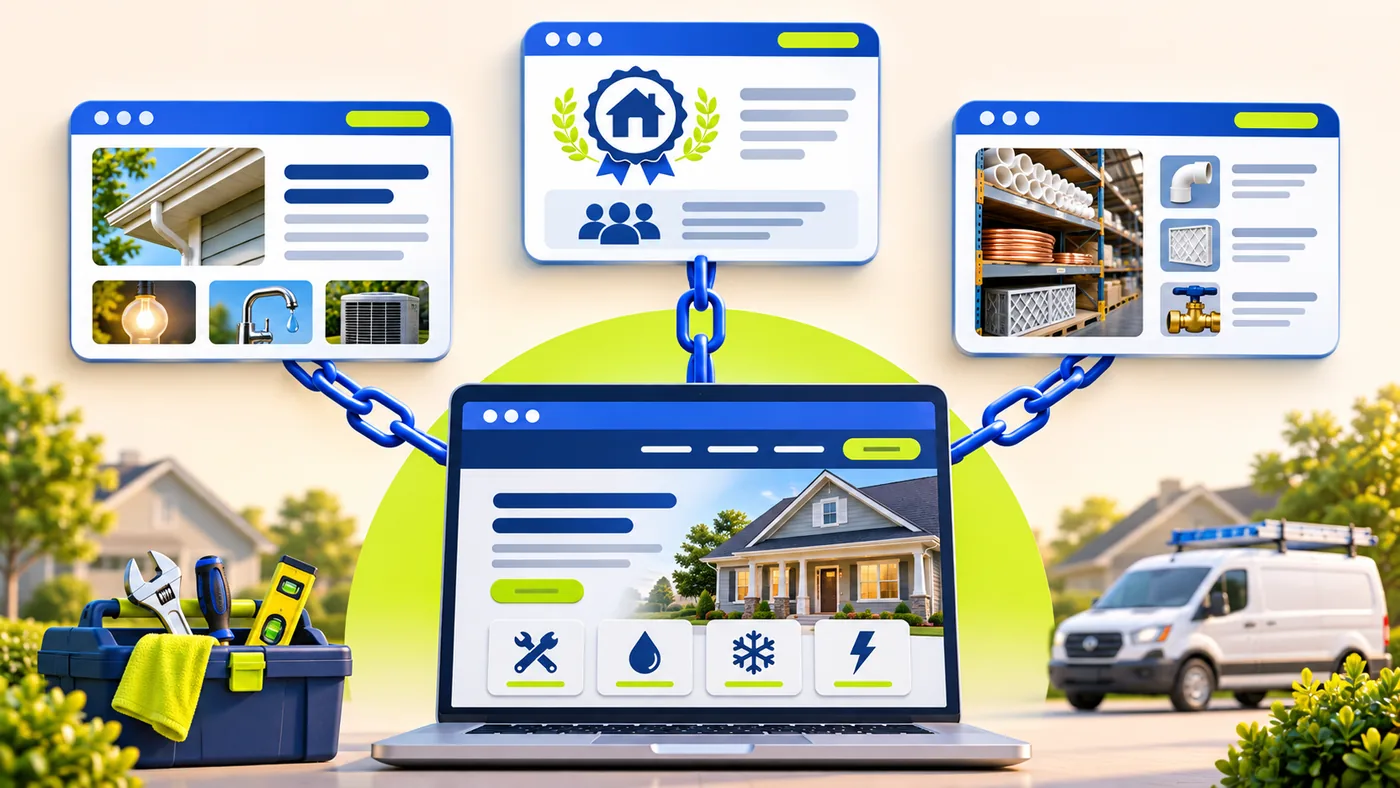
The fastest way to get backlinks is to collect the ones your business has already earned: suppliers, partners and sites that mention you without linking. Only after that does it make sense to create something worth citing and pitch it. Cold pitching is the expensive part. In a Backlinko and Pitchbox analysis of 12 million outreach emails, only 8.5% got any reply.
This guide is for owners of small business sites who want more links without paying a link seller or tripping Google's spam filters. It goes through where to get backlinks in the order we would work on them, how much effort each tactic takes, and which shortcuts Google's own policies call spam.
One line of definition, then the work. A backlink is a link from another website to yours, and Google's link best practices say Google uses links "as a signal when determining the relevancy of pages."
Step 0: measure the link gap before you build anything
Before you build backlinks, set a target based on the sites that outrank you, not on a generic number. Pull the referring domains for the top 3-5 competitors on your main search term and compare them with your own.
How you filter changes the answer. In our audits we count only strong, live links: referring domains with an Ahrefs Domain Rating (DR) of 30 or higher and at least 500 monthly organic visits. A raw total includes dead links, scraper copies and throwaway directory listings. The filtered count is our working benchmark, not a ranking requirement. DR and estimated traffic are third-party metrics; relevant local or specialist sites can be useful even below those thresholds.
Then look for overlap. A domain that links to two or more of your competitors but not to you has already shown it links to businesses like yours, so it goes to the top of your outreach list. Ahrefs calls this report Link Intersect.
Small and new sites often show no data in Ahrefs at all. For those, the Links report in Google Search Console shows which sites Google already sees linking to you.
Is it worth the work? Ahrefs' 2023 search traffic study estimated that 96.55% of roughly 14 billion pages in its Content Explorer database received no Google search traffic. The sample is not the whole web, and low-volume searches can fall outside the estimates. Of about 20 million pages with no referring domains, only 2,997 got more than 1,000 monthly search visits. Ahrefs points out that this is a correlation, not proof that links cause rankings. Still, a page with zero links is fighting uphill.
Step 1: ask for the links you have already earned
These take one email each, because the relationship already exists. Make a list of every company that knows your business: the brands you sell or install (many run "where to buy" or certified installer pages), associations you pay dues to, business customers, and companies you refer work to. Check each one for a link to your site and email the ones that are missing.
Then catch the mentions. Set up Google Alerts for your business name, the owner's name and any branded products. When a news site, blog or event page names you without a link, email the author, quote the exact sentence and suggest the single URL that helps their readers. Four of the five top-ranking guides we reviewed for this article list this tactic, and it is the cheapest pitch you will ever send: the writer already decided to mention you.
If you run a local business, there is a longer list of community sources (sponsorships, chambers, local press) that deserves its own plan. Directory listings are a separate job too. Google's spam policies list "low-quality directory or bookmark site links" as link spam, so treat directories as listings for customers and keep them accurate through your Google Business Profile and local search work, not as a link source.
Step 2: fix links that point to pages you deleted
Site redesigns break links. When you rename a service page or drop an old URL, other sites keep linking to it and their visitors land on a 404 page.
Ahrefs, Semrush and similar tools list your URLs that return errors while still receiving links. For each one, restore the useful content or add a 301 redirect to a genuinely equivalent live page. If no relevant replacement exists, keep the appropriate 404 or 410 response instead of redirecting to an unrelated page. If the link comes from a site you know, you can also ask them to update it. No pitching, no new content. This is usually the quickest win on the whole list.
Step 3: publish one page other sites want to cite
Most sites do not link to service pages. They link to pages that help their own readers. For a small business, the strongest linkable page is built on information you have because you do the work every day:
- A cost guide built from your own jobs or orders, with ranges and the factors that move the price.
- A rules explainer for your field: permits for a contractor, filing deadlines for a bookkeeper, licensing steps for a salon owner. Link to the official sources.
- A seasonal checklist (pre-winter for a plumber, pre-tax-season for an accountant).
- A calculator or comparison table that answers a question customers ask on the first call.
- A short survey of your own customers, published with the method and the sample size.
Our position: one well-researched page like this does more for link building than ten generic blog posts. A generic post gives another site nothing to cite. The same rule answers how to get backlinks for a blog. Publish posts that contain something to reference, such as a number, a template, a rule or a clear definition, and pitch those posts, not your newest opinion piece.
Step 4: pitch specific pages to specific people
Outreach is where most of the hours go, so know the odds first. The Backlinko and Pitchbox study (published in 2019) measured how small changes to an email moved the reply rate:
| Change to the outreach email | Effect on replies |
|---|---|
| One follow-up message | 65.8% more replies |
| Personalized email body | 32.7% more replies |
| Personalized subject line | 30.5% higher response rate |
| Emailing several contacts at the same organization | 93% higher response rate |
Here is an illustration using that historical 8.5% reply rate. In a comparable sample, 100 emails would yield roughly 8 or 9 replies, and a reply is not a link. Your current response rate may differ. If one in three replies turns into a link (an example figure, not a benchmark), that is about 3 links per 100 emails. That math is why Steps 1-3 come first.
Where to send those emails:
- Resource pages: "helpful links" pages run by libraries, city offices, schools and associations.
- Broken links on relevant sites. Find a dead link on a page in your field, then offer your page as the replacement.
- "Best of" roundups and buyer's guides that list businesses like yours.
- Newsletter writers and bloggers who cover your trade or your area.
Keep the email short. Name their page, the place your link fits and why it helps their readers. For example: "Your 'Hurricane prep resources' page links to a checklist that now returns a 404. We published a pre-storm checklist for homeowners last month; it might work as a replacement." Send one follow-up a few days later, then stop.
Step 5: answer journalist requests
Writers constantly need sources, and a quote with a link is one of the cleaner ways to earn backlinks. HARO is active: its official site currently offers free daily media queries and identifies Featured as the operator. Subscribe to relevant requests, but remember that a published quote does not guarantee a backlink.
Answer only the queries where you have specifics: prices you actually charge, rules you deal with, the questions customers ask most. Speed counts, because writers tend to use the first few usable answers. Podcast guest spots work the same way and often come with a link in the show notes.
Step 6: write guest posts where your customers already read
Guest posting works when the publication's readers are your buyers. It stops working when it turns into a volume game. In a July 2021 post on qualifying links, Google said that sites publishing or acquiring links through "excessive sponsored and guest posting" without proper link tags may face algorithmic and manual actions.
So pick two or three outlets that matter to your customers: a trade publication, the regional business journal, a partner's blog. Use your brand name or URL as the anchor text, since Google's spam policies name "links with optimized anchor text in articles, guest posts, or press releases" as spam. If the publisher marks the link nofollow or sponsored, accept it. A post that sends real customers is worth writing either way.
How much effort each way to get backlinks takes
The table below is our assessment of effort and risk for a typical small business site, not measured data. Use it to decide where your first month goes.
| Tactic | Effort | Out-of-pocket cost | Risk | Best fit |
|---|---|---|---|---|
| Ask suppliers, partners and associations for links | Low | Usually none | None | Every business |
| Unlinked mentions | Low, ongoing | None | None | Businesses that get press or event mentions |
| Fix broken backlinks with redirects | Low | None | None | Sites that went through a redesign |
| One linkable page (cost guide, checklist, calculator) | High | Your time or a writer | None | Businesses with real job or customer data |
| Outreach to resource pages and broken links | High | Time | Low | Sites with a page worth linking to |
| Journalist requests and podcasts | Medium | Time | None | Owners who can speak on the record |
| Guest posts | Medium to high | Time | Medium if anchors are keyword-stuffed | Businesses with a trade or regional publication audience |
Shortcuts Google's spam policies name
Paid link packages are easy to find. An Ahrefs article on buying backlinks, updated in July 2024, reports a historical average of $361.44 for a paid link inserted into an existing page, based on outreach to 450 sites. This is an old study, not a current market quote. Google is direct about links like that. Each row below quotes or paraphrases the spam policies page.
| Shortcut | What Google's spam policy says | What to do instead |
|---|---|---|
| Buying links or paid niche edits | Buying or selling links for ranking purposes is link spam | Pay for real sponsorships and accept a sponsored tag |
| Link swaps | "Excessive link exchanges" are link spam | Link to partners where a real relationship exists |
| Automated link tools and bulk packages | Using automated programs or services to create links is spam | Send fewer pitches, by hand |
| Mass directory submissions | Low-quality directory or bookmark links are spam | Keep a short list of directories your customers use |
| Keyword-stuffed anchors in guest posts or press releases | Optimized anchor text in these places is spam | Use your brand name or URL |
| Footer or widget links on other sites | Widely distributed footer, template and widget links are spam | Earn one editorial link instead |
| Forum and blog comments with links | Optimized links in posts or signatures are spam | Join the discussion without the link |
Paid links are allowed when they are labeled. Google's page on qualifying outbound links asks sites to mark ads and paid placements with rel="sponsored". That addresses Google's paid-link qualification requirement. It also means the link is not meant to pass ranking credit.
How to create backlinks step by step in your first 90 days
This is the order we suggest for a small business site starting with few or no strong links. Stretch the weeks if you are doing it alone.
- Weeks 1-2: run the gap analysis from Step 0. Count only live referring domains with DR 30+ and 500+ monthly visits, for you and for 3-5 competitors.
- Weeks 2-4: ask suppliers, partners and associations for the links you are missing. Set up Google Alerts.
- Weeks 3-4: redirect old URLs that still receive links.
- Weeks 5-8: build one linkable page from your own job or customer data.
- Weeks 7-12: pitch that page to resource pages, broken-link targets and writers in your field, with one follow-up per email. Answer journalist requests as they come in.
- Week 12: recount live, strong referring domains with the same filter you used in week 1, so the comparison is fair.
FAQ
How can I get backlinks for free?
Start with relationships you already have: suppliers, partners, associations and business customers. Then claim unlinked mentions, redirect old URLs that still receive links, and answer journalist requests. All of these cost time, not money.
How much do backlinks cost?
Earned backlinks cost time. Paid links are a different thing: Ahrefs reports a historical average of $361.44 for a paid niche edit from an older 450-site study, cited in its July 2024 article; it is not a current price benchmark. Google treats links bought for ranking purposes as spam unless they carry rel="sponsored" or rel="nofollow".
How long does it take to get backlinks?
Links you ask partners for, and redirects you set up yourself, can count within days of the fix or the reply. A new linkable page takes longer, because people have to find it or hear about it from your outreach first. Plan in quarters, not weeks.
How do I get backlinks to my website if it is brand new?
Start with Steps 1 and 5. A new site has no authority, but it does have a business behind it, and those two steps do not depend on your site's metrics at all: a supplier lists you because you sell their product, and a writer quotes you because your answer was useful.
Do nofollow backlinks help?
They can send visitors and customers. Google generally does not follow links marked nofollow, sponsored or ugc, according to its page on qualifying outbound links, so do not count on them for rankings. A nofollow link from a trade publication your buyers read is still worth having.
How do I get good backlinks instead of junk?
A good backlink comes from a real site your customers or your industry pay attention to, sits inside the content and uses natural anchor text. As a filter, we look for referring domains with DR 30+ and 500+ monthly organic visits, and we count only links that are still live.
Your first move
Open a spreadsheet and list every supplier, partner, association and business customer you have. Check each for a link to your site and email the ones that are missing. Nothing on that list requires pitching strangers.
When you are ready for the harder steps (the gap analysis, the linkable page, the outreach), our link building service handles them as part of a wider SEO program. If you run a home service company, our guide to SEO for home service businesses shows where links fit next to your site and map listing, and the mentions you earn also feed into your AI visibility. We start with your goals, service area and existing lead flow, then agree on the work that fits your business. Get in touch and we will reply the same business day.
Put the next step into action.
Tell us about your business, service area and goals.
Get More LeadsExplore link building services